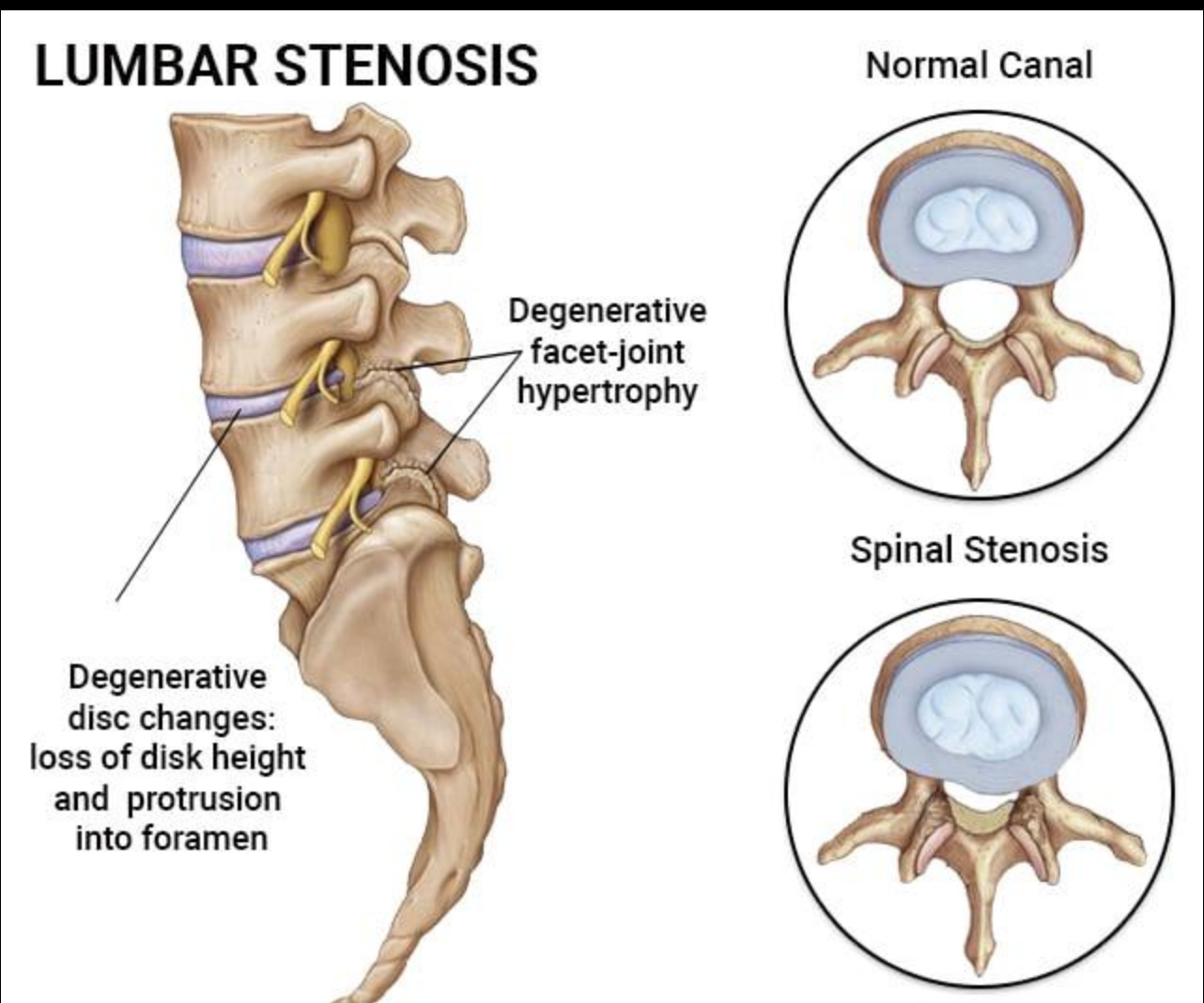
Lumbar spinal stenosis occurs when the spinal canal in the lower back becomes narrowed, potentially putting pressure on the nerves traveling into the legs.
Exercise is often an important part of managing lower-back conditions, but when you have lumbar spinal stenosis, the type of exercise and the way you perform it matter. Certain movements can aggravate symptoms by placing additional stress on the lower back or increasing irritation around already compressed nerves.
Common symptoms include lower-back discomfort, leg pain or cramping, numbness, tingling, and weakness. Symptoms often become more noticeable during prolonged standing or walking and may improve when sitting or leaning forward.
The good news is that having spinal stenosis does not automatically mean you should stop exercising. Appropriate physical activity and physical therapy can help maintain flexibility, stability, strength, endurance, and balance. The goal is to choose movements suited to your condition and avoid exercises that repeatedly trigger or worsen symptoms.
Quick Answer: Yes, some exercises can temporarily worsen lumbar spinal stenosis symptoms, particularly movements or positions that provoke back or leg pain, numbness, tingling, or weakness. However, avoiding all physical activity is usually not the answer. A physician or physical therapist can help develop an exercise program based on your symptoms, mobility, and overall spinal health.
What Is Lumbar Spinal Stenosis?
The lumbar spine consists of five vertebrae in the lower back. Lumbar spinal stenosis refers to narrowing of the spinal canal in this area, which can reduce the space available for the nerves.
Age-related degenerative changes are a common cause. Over time, discs can lose height or bulge, facet joints can enlarge, and spinal ligaments can thicken. These changes may contribute to narrowing around the nerves.
If you would like to learn more about treatment options for Lumbar Spinal Stenosis, a spine specialist can evaluate the cause and severity of your symptoms and recommend an appropriate treatment plan.
Can Exercise Make Lumbar Spinal Stenosis Worse?
It can—if a particular exercise aggravates your symptoms or places your spine in a position you do not tolerate well.
Many people with symptomatic lumbar spinal stenosis experience discomfort during standing and walking that improves when they sit or bend forward. This pattern is associated with neurogenic claudication caused by nerve compression.
That does not mean every exercise involving standing or spinal extension is universally unsafe. Lumbar spinal stenosis varies considerably from one person to another. An exercise that causes symptoms in one patient may be tolerated by another.
Instead of thinking in terms of universally “good” and “bad” exercises, pay attention to how your body responds. Increasing radiating leg pain, numbness, tingling, heaviness, or weakness during an activity deserves particular attention.
7 Movements and Exercises to Approach Carefully
- Repeated or Deep Backward Bending
Exercises that repeatedly place the lower back into significant extension may aggravate symptoms in some people with lumbar spinal stenosis.
Examples can include:
- Deep standing backbends
- Repeated lumbar extensions
- Certain yoga backbends
- Exercises involving prolonged arching of the lower back
Because many people with lumbar stenosis feel better when bending forward, movements in the opposite direction can sometimes be less comfortable. However, this is not universal, so individualized assessment is important.
- Heavy Weightlifting with Poor Technique
Strength training itself is not necessarily off-limits. In fact, strengthening the muscles that support the spine can be an important component of rehabilitation.
Problems can arise when someone lifts more weight than they can safely control or performs an exercise with poor spinal positioning.
Heavy squats, deadlifts, overhead presses, or loaded carries may need to be modified depending on symptoms, strength, balance, and the severity of stenosis.
A physical therapist or qualified healthcare professional can help determine whether resistance training is appropriate and how it should be modified.
- High-Impact Exercise That Triggers Symptoms
Running, jumping, plyometrics, and similar high-impact activities are not automatically prohibited for every person with lumbar spinal stenosis. However, repeated impact may be poorly tolerated by some patients.
If jogging or jumping consistently causes increasing back pain, radiating leg symptoms, numbness, or weakness, continuing through those symptoms may not be appropriate.
Lower-impact cardiovascular activities may be easier to tolerate while still supporting overall fitness.
- Prolonged Upright Walking When Symptoms Are Increasing
Walking is often encouraged as part of staying active, but lumbar spinal stenosis commonly causes leg pain or cramping after prolonged standing or walking. Symptoms often improve when sitting or bending forward.
Instead of pushing through progressively worsening symptoms, some people may benefit from:
- Shorter walking intervals
- Planned rest periods
- Walking at a comfortable pace
- Using appropriate support when recommended
- Choosing cardiovascular exercise that allows a slightly flexed posture
A healthcare professional can help establish appropriate limits.
- Exercises Requiring Excessive Spinal Twisting
Forceful or rapid twisting movements may aggravate back symptoms in some people, especially when combined with resistance.
Be cautious with exercises involving fast trunk rotation or loaded twisting if they reproduce your symptoms. Controlled mobility exercises may be preferable, depending on your individual condition.
- High-Intensity Workouts Without Gradual Progression
Going directly from inactivity to an intense workout can be difficult for anyone, but it can be particularly problematic when dealing with a symptomatic spinal condition.
Instead, exercise programs generally should progress gradually. Physical therapy may help build strength and endurance while maintaining flexibility and spinal stability.
- Any Exercise That Causes New Neurological Symptoms
Perhaps the most important rule is to pay attention to neurological symptoms.
Stop the activity and seek medical guidance if exercise causes significant or progressive:
- Leg weakness
- Numbness
- Tingling
- Radiating leg pain
- Difficulty walking or maintaining balance
New bowel or bladder control problems can indicate serious nerve involvement and require urgent medical assessment.
What Exercises May Be Better for Lumbar Spinal Stenosis?
There is no single exercise program that works for everyone. However, treatment programs often focus on maintaining mobility while strengthening the muscles that support the spine.
Physical therapy can incorporate exercises intended to improve posture, stretch the lower back and lower limbs, address radiating symptoms, and strengthen core and trunk muscles.
Depending on your medical history and symptoms, a professional may recommend activities such as gentle flexibility work, controlled core strengthening, low-impact aerobic exercise, or other individually selected movements.
The important point is that exercise should be adapted to the patient rather than forcing the patient to adapt to a generic workout.
Should You Stop Exercising If You Have Spinal Stenosis?
Usually, the goal is not complete inactivity.
Exercise, stretching, posture management, and physical therapy are among the nonsurgical approaches commonly used to manage lumbar spinal stenosis. AANS notes that prescribed exercise or physical therapy can help stabilize and protect the spine while building endurance and flexibility.
Mayo Clinic similarly advises remaining active when possible and stopping activities that increase pain rather than avoiding activity solely because of fear of pain.
The key difference is between productive movement and symptom-provoking movement.
How Do You Know If an Exercise Is Making Stenosis Worse?
Muscle fatigue after a workout is different from an increase in neurological symptoms.
Consider stopping or modifying an exercise if you repeatedly experience:
- Increasing pain extending into the buttock or leg
- New or worsening numbness
- Tingling that becomes more intense
- Increasing leg heaviness
- New weakness
- Reduced ability to walk after exercise
- Symptoms that remain significantly worse after the workout
A symptom diary can sometimes help. Note which activities you perform, how long you perform them, when symptoms begin, and which positions relieve them. This information can be useful when discussing your condition with a physician or physical therapist.
When Should You See a Spine Specialist?
Consider a medical evaluation when lower-back or leg symptoms interfere with walking, standing, work, exercise, sleep, or normal daily activities.
A spine specialist can determine whether symptoms are actually caused by lumbar spinal stenosis or another condition. Imaging such as MRI or CT may be used as part of an evaluation when clinically appropriate. Treatment depends on symptom severity and can range from physical therapy and other conservative approaches to procedures or surgery for selected patients.
Surgery is generally considered when nonsurgical treatment does not provide adequate relief or when significant neurological problems develop.
Frequently Asked Questions
- What exercises should I avoid with lumbar spinal stenosis?
There is no universal list that applies to every patient. Exercises involving repeated deep back extension, heavy loads, high impact, or forceful twisting may aggravate symptoms in some people. More importantly, modify or stop any exercise that consistently increases radiating pain, numbness, tingling, or weakness.
- Is walking bad for lumbar spinal stenosis?
Not necessarily. Walking can be beneficial, but prolonged walking or standing commonly triggers symptoms in people with symptomatic lumbar stenosis. Shorter intervals, rest periods, or modifications recommended by a healthcare professional may make exercise more manageable.
- Can I lift weights with spinal stenosis?
Some patients can perform resistance training safely with appropriate technique and modifications. Your ability to lift weights depends on the severity of your stenosis, symptoms, other spinal conditions, overall health, and the specific exercise. Ask your physician or physical therapist before beginning heavy resistance training.
- Are squats bad for lumbar spinal stenosis?
Squats are not automatically unsafe. Technique, depth, load, mobility, and symptoms all matter. If squatting produces increasing back or leg symptoms, the movement should be assessed and potentially modified.
- Can stretching make spinal stenosis worse?
Gentle stretching may be part of a physical therapy program, but aggressive stretching or movements that reproduce neurological symptoms should not simply be pushed through. A physical therapist can identify stretches appropriate for your condition.
- Is cycling good for lumbar spinal stenosis?
Some people find cycling more comfortable because it can involve a forward-flexed position. Whether cycling is suitable for you depends on your individual symptoms, balance, mobility, and other health conditions.
- Can exercise cure lumbar spinal stenosis?
Exercise does not physically reverse the structural narrowing of the spinal canal. However, an appropriate exercise and physical therapy program may improve strength, endurance, flexibility, balance, and function while helping some people manage their symptoms.
- When should I stop exercising and contact a doctor?
Seek medical advice for new or progressive weakness, significant numbness, worsening difficulty walking, or severe symptoms that do not settle after stopping the activity. New bowel or bladder dysfunction warrants urgent medical attention.
Stay Active—But Choose the Right Movements
Lumbar spinal stenosis does not necessarily mean giving up exercise. Staying active can be an important part of maintaining strength, flexibility, endurance, and independence. The key is finding activities that support your spine without repeatedly provoking your symptoms.
Because lumbar spinal stenosis affects people differently, an individualized evaluation can help determine which exercises are appropriate and whether additional treatment is needed.
Schedule a Consultation with Dr. Alok Sharan
If lumbar spinal stenosis is causing persistent back pain, leg pain, numbness, weakness, or difficulty walking, Dr. Alok Sharan can evaluate your condition and discuss treatment options based on your individual needs.
Call Dr. Alok Sharan at 732-898-3950 to schedule a consultation.


